
Initiatives
Roadmap, appeals and briefings
Since 2020, EarthTeam (formerly EndPandemics) has published practical guidance on preventing the next pandemic. Download the documents in the language you need.
Roadmap
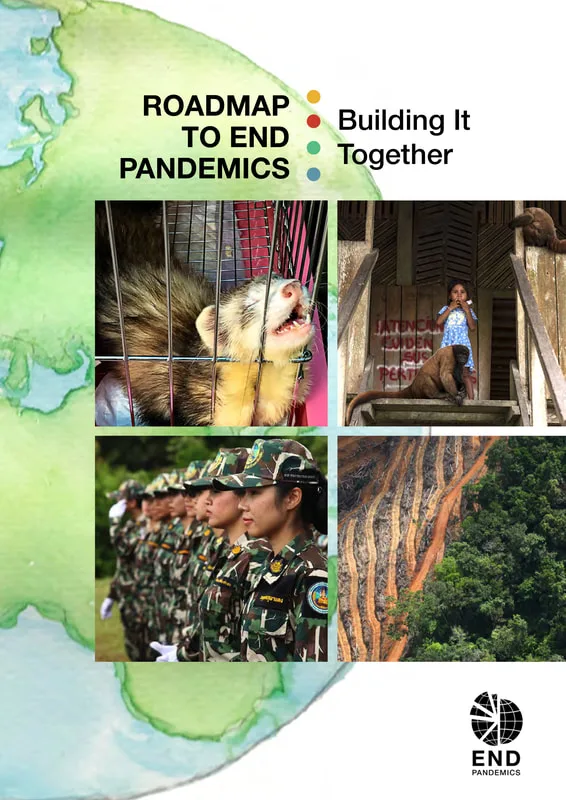
Roadmap to End Pandemics: Building It Together
Practical guidance on how to prevent the next pandemic
Having caused more destruction and disruption than any terrorist act or natural disaster in the last 100 years, COVID-19 shook our world and convinced the global community that we must do all we can to prevent another pandemic. But how? Regenerating our world requires a regenerative approach, and this Roadmap lays it out.
The multi-language Roadmap is a living, interactive tool designed by EarthTeam (formerly EndPandemics) for governments, organizations, corporations, civil society and individuals across the globe. It gives concrete, practical guidance on how to prevent the next pandemic. Use it, and join the global community that created it as we keep refining and jointly implementing solutions, on the path out of this self-inflicted Pandemics Era and into a more secure world.
Download PDF · 4 languages
G20 appeal · 2021
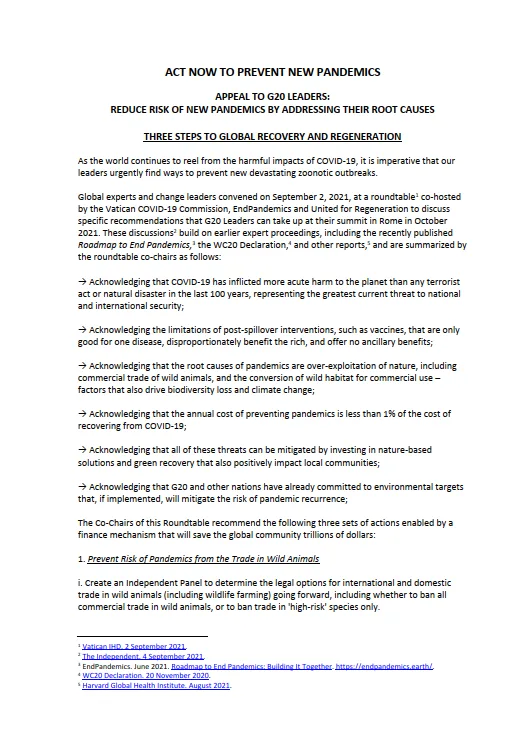
Appeal to G20 Leaders
Reduce risk of new pandemics by addressing their root causes: three steps to global recovery and regeneration
As the world continued to reel from COVID-19, our leaders needed to find ways to prevent new zoonotic outbreaks. In 2021 the Vatican COVID-19 Commission, EarthTeam (formerly EndPandemics) and United for Regeneration convened a roundtable on recommendations G20 leaders could take up at their October 2021 summit in Rome.
The recommendations: 1) prevent the risk of pandemics from the trade in wild animals; 2) prevent the risk of pandemics caused by destructive land-use practices; and 3) establish a Planetary Health defence funding mechanism.
Download PDF · 9 languages
White paper · 2021
Stop the New Global Terror: Pandemics
Pandemics, a threat to international security: the case for a Planetary Security Program
Published in 2021 by EndPandemics, the Analytical Center of Excellence on Trafficking and United for Regeneration. The authors recognise pandemics as a global threat and recommend repurposing well-funded national security programs, linking them to environmental, agricultural and development programs to scale up pandemic prevention.
The paper argues that One Health is the best strategy for a multi-sector, global approach to preventing more COVID-like outbreaks.
Download PDF
Briefing pack
How these 3 “COPs” can help #EndPandemics
COP27 (Climate Change), COP19 (CITES) and COP15 (Convention on Biological Diversity)
Their relevance to preventing future zoonotic outbreaks.
Download PDF
Resources
Essential tools
Earth needs help. Global warming, species and biodiversity loss, and pandemics are on the rise, and nobody can do this on their own. These toolkits put frontline knowledge in more hands.
iTHINK Behavior Change Toolkit
Changing the behaviour of existing and potential consumers of wildlife is key to reducing long-term pressure on endangered species. iTHINK is a comprehensive suite of materials that can be tailored to any situation.
Wildlife Friendly Skies Toolkit
Helps everyone identify commonly trafficked wildlife and wildlife parts. Designed for frontline law enforcement officers and transport sector workers to identify, report and handle commonly trafficked species.
WildScan smartphone app
Identify commonly trafficked wildlife and wildlife parts. Built for frontline law enforcement and transport workers, it also encourages civil society to report wildlife in local markets.
Watch